
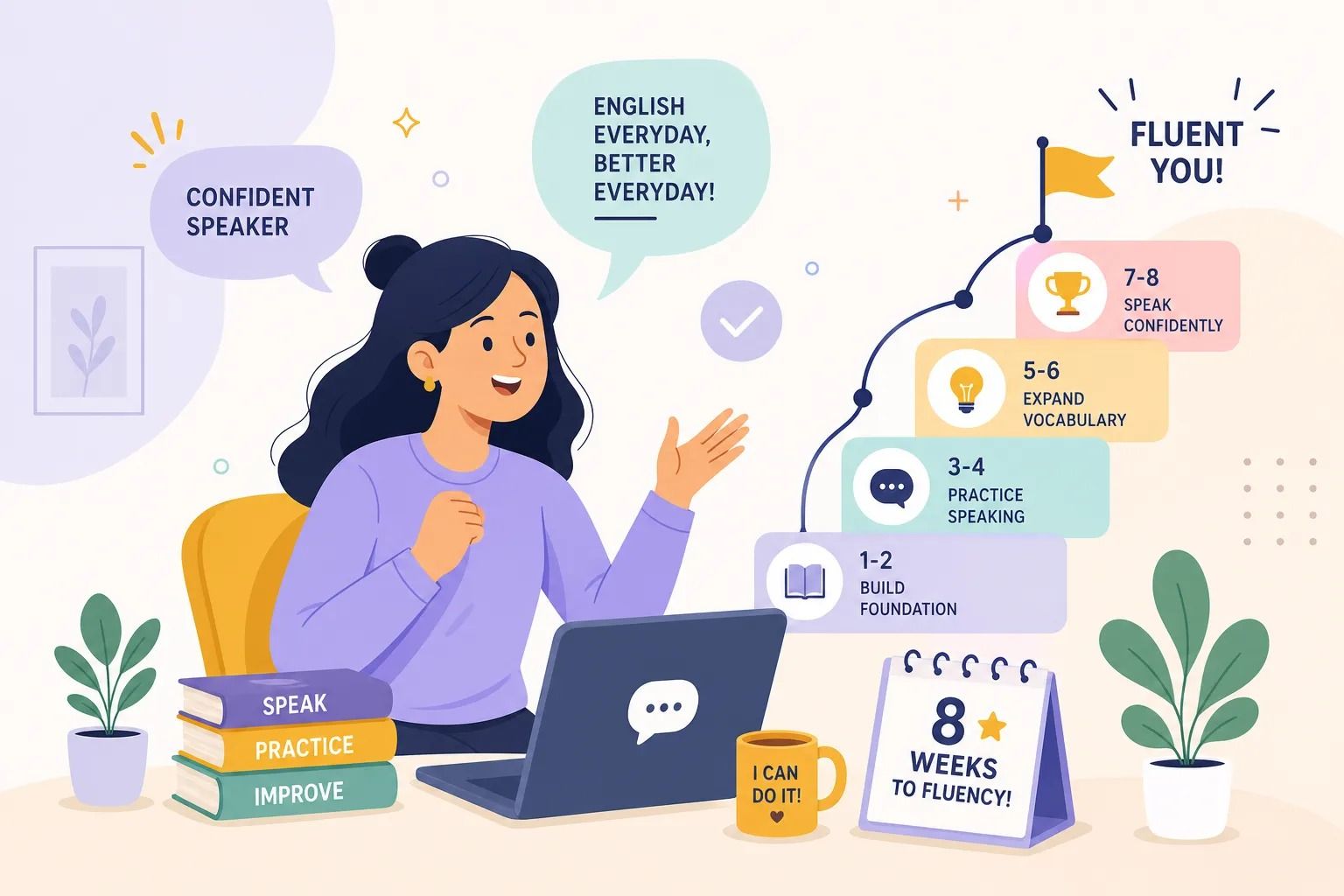
Speak English Fluently: Your 8-Week Roadmap for Indians
Most Indians who want to speak English fluently face the same paradox: years of grammar instruction, yet complete silence the moment someone asks them to say something. Many Indian learners begin formal English instruction in early primary school. They know tenses, articles, and vocabulary lists by heart. Yet the moment someone asks them to speak, they go blank. The mind races, the words disappear, and that familiar panic sets in.
Grammar alone is rarely the limiting factor. For most learners, the real obstacle is the near-complete absence of actual speaking practice. Fluency is not built by reading rules. It is built by opening your mouth, repeatedly, until your brain stops translating and starts thinking in English. Decades of second language acquisition research point clearly to one conclusion: spoken output, not grammar instruction alone, is what builds the neural pathways for fluent speech.
This 8-week plan is designed specifically for busy Indian learners. It gives you a phase-by-phase speaking routine, daily exercises, the right tools, and weekly targets so you always know exactly where you are and what to do next. With consistent effort, many learners report a significant reduction in the pause-and-translate loop by Week 8, though progress will vary depending on your starting level and how many days you actually put in.
Why grammar drills keep you stuck (and what actually builds fluency)
Fluency is a motor skill, not a knowledge test. The brain automates language through repetitive output, just as a musician builds muscle memory through daily practice. Research on spaced repetition and habit formation suggests that short, daily speaking sessions tend to outperform sporadic longer ones, because consistency compounds in ways that occasional intensity cannot. Once speaking becomes automatic at a certain level, comprehension and vocabulary acquisition speed up in parallel.
The Indian school system deserves some credit here: it produced generations of people who can read and write English competently. But decades of reading-and-writing focused education leave many learners with strong passive knowledge and very little active output experience. The result is the translation habit: thinking in Hindi or a regional language, then converting to English in real time. That conversion lag, even a fraction of a second, is precisely what produces the sensation of “freezing” when you speak.
The fix is not more grammar revision. It is consistent speaking practice, starting today, even if what comes out sounds imperfect. Mistakes at the early stage are not a problem, they are the entire point. For a deeper look at why conversation matters for fluency, see this piece on English conversation practice, which explains how regular output changes the way your brain uses language.
How to speak English fluently: the 8-week plan
Weeks 1, 2: Building the speaking foundation
The goal in these two weeks is simple: get comfortable producing English sounds and sentences every single day, even when you are alone. Start with a daily routine built around three short activities:
- 5 minutes of mouth and jaw warm-ups (jaw circles, tongue push-outs, lip rounding) to loosen the articulators and improve pronunciation clarity.
- 2 to 3 minutes of unscripted narration, describe what you are doing or seeing right now, in English, out loud.
- 1 minute of end-of-day reflection spoken aloud, what happened, what you noticed, what you will do tomorrow.
This routine takes less than 10 minutes and works during a morning commute or while making tea. If you are at the A2 level or below, aim for a 60-to-90-second narration before stretching to two minutes. The content matters far less than the act of producing continuous spoken English every day.
Week 2 Milestone: Complete a 2-minute self-introduction without stopping to think. Keep it simple: your name, where you are from, what you do, and one thing you enjoy. The content matters less than the act of speaking continuously without freezing.
Weeks 3, 5: Shadowing, rhythm, and real sentences
This is where the real work begins. Shadowing ranks among the most effective techniques available for improving rhythm, intonation, and natural phrasing. Watch a short video clip, pause it, and imitate the speaker word-for-word, including their rhythm and emotion. Start with the transcript in front of you, then progress to audio-only as you get comfortable. Good content options for Indian learners include Coffee Break English podcast episodes, TED-Ed explainer videos, and short clips from Indian English news anchors.
There is a simple trick that makes shadowing click faster: be dramatic. Exaggerate the speaker’s emotion and stress patterns. This helps you internalise the full prosody of English, not just the individual words. Record your shadowing, then play it back next to the original. The gaps in your rhythm and pronunciation become immediately obvious, and you can target them precisely. For a practical guide to the shadowing technique, check that resource to see step-by-step examples and practice tips.
Week 5 Milestone: Shadow a 30-second clip accurately and record a 3-minute story on any topic from memory. If you can do both, you are ahead of schedule.
Weeks 6, 8: Live conversations and pressure-testing
Solo practice has a ceiling. Fluency accelerates when you are forced to respond to a real person in real time, with no script and no pause button. These final three weeks are about introducing live English conversation practice through role-play scenarios, such as a job interview or politely pushing back in a disagreement, and eventually unscripted conversations with unfamiliar speakers.
Week 8 Milestone: Hold a 5-minute unscripted conversation with someone you do not know well, without reverting to translation mode. Learners who reach this milestone consistently describe it as the point where English starts to feel like communication rather than performance.
Daily speaking exercises that compound over time
The 10-minute routine you will actually stick to
The routine breaks down like this: 5 minutes of physical warm-ups, 2 to 3 minutes of unscripted speaking, and 1 minute of reflective recap at the end of the day. The physical warm-up matters more than most learners realise. It loosens the articulators, reduces jaw tension, and directly improves pronunciation clarity. Think of it as warming up before a run.
The unscripted segment is where fluency actually builds. Set a 2-minute timer and narrate your surroundings, explain something you read that morning, or describe your plans for the day. The topic is irrelevant. The output is what trains the brain. Do this every single day, not just on days when you feel motivated. For extra daily prompts and exercises you can follow, see this list of daily English exercises to improve your skills.
Pronunciation drills for common Indian English errors
Five specific sounds cause the most difficulty for Indian speakers, and each has a targeted drill for your English speaking practice:
- Retroflex T and D: Hold a piece of paper in front of your mouth and say “top” or “dog.” The paper should move with a visible puff of air. If it does not, you are using the Indian retroflex instead of the English aspirated consonant.
- V versus W: For V, touch your upper teeth to your bottom lip. For W, round your lips into a tight circle. Practise “very” against “wery” until the lip positions feel automatic.
- TH sounds: Place your tongue tip gently between your teeth and push air through. Practise “think” against “tink” and “that” against “dat.”
- S versus Z: Place your hand on your throat. S produces no vibration; Z produces a hum. Practise minimal pairs: “sip and zip,” “sink and zinc.”
- Flat intonation: Indian English often uses level intonation where standard English uses a falling tone for statements. Read sentences aloud and consciously stress only the keywords, letting your pitch fall at the end.
Use one sound per day across a full week before moving to the next. This focused approach produces measurable results far faster than trying to fix everything simultaneously. For a helpful guide specifically aimed at Indian speakers, visit this article on English pronunciation for Indian speakers with practical drills and examples.
Tools and live practice spaces worth your time
Apps that give real pronunciation feedback
Two apps stand out for Indian learners specifically. ELSA Speak analyses speech at the phoneme level and shows you exactly which sounds are off; users report measurable accuracy gains after several weeks of consistent daily use. MySivi is built specifically for learners transitioning from Hindi or regional languages and flags India-specific errors that generic apps miss entirely.
Use app feedback as a diagnostic tool, not a conversation substitute. Apps tell you what is wrong. They cannot simulate the real communication pressure of responding to a live person. That distinction matters enormously for fluency development.
Why live conversation rooms help you speak fluent English faster than any app
Apps react to your speech. Real people respond to your meaning, your hesitation, and your emotion. That difference is the difference between drilling and actually communicating. Every serious language teacher will tell you the same thing: live conversation accelerates adaptive fluency because the unpredictability of real human responses forces your brain to stop translating and start responding. No AI simulation fully replicates that pressure.
This is why the final weeks of this plan prioritise live conversation. Talk4now gives Indian learners access to live voice conversation rooms with real speakers from around the world, for free, with no scheduling required. You can practice English speaking online, live practice with real people any time, even at 11 pm after a long workday.
The platform’s listen-first model is particularly well-suited for anxious speakers: you can sit in a live room, listen to natural conversation happening in real time, and join only when you are ready. There is no pressure to perform on day one.
Real-time rooms force spontaneous thinking. When you cannot pause the conversation, you stop translating and start responding. That shift, from practised to natural, is exactly how fluency compounds week over week. For a practical guide on how to practice speaking English with confidence, see Talk4now’s step-by-step guide.
Tracking your progress and staying consistent across 8 weeks
Weekly milestones that tell you exactly where you stand
Set these as non-negotiable checkpoints:
- Week 2: Narrate a 2-minute story aloud without stopping.
- Week 4: Shadow a 30-second clip and match the original rhythm.
- Week 6: Sustain a 3-minute unscripted conversation on a familiar topic.
- Week 8: Hold a 5-minute conversation with an unfamiliar speaker without the translation lag.
Record yourself every Friday and compare it to the previous week’s recording. This is the clearest feedback loop available without a tutor. Progress in fluency is gradual enough that you will not notice it day to day. But week-on-week comparisons make it impossible to miss. If you want to read more about the role of output in second language acquisition, this review examines the scope of output and its implications for learning.
English fluency tips: habits that separate fluent speakers from learners who plateau
The most fluent non-native speakers share one trait: they never stopped producing English outside of formal study. They narrate their commute in English inside their head. They describe their lunch to no one in particular. They consume English content actively, pausing to repeat phrases rather than passively watching.
These micro-habits accumulate into noticeable fluency gains over weeks, though moving up a full CEFR level typically takes months of sustained effort at this kind of intensity.
Building a speaking community matters just as much as solo practice. Practice partners, accountability buddies, and open conversation rooms keep you speaking even on days when motivation is low. Talk4now’s community of multilingual speakers includes learners at every level, which means you can generally find someone to practise with regardless of your current proficiency. Fluency is not a destination you arrive at. It is a daily practice that becomes lighter and more natural with every week you put in.
Start this week, not next Monday
Eight weeks is enough time to build a speaking habit that will keep compounding long after the plan ends. It is not a shortcut, it is the minimum viable commitment. CEFR benchmarks suggest that moving from B1 to conversational B2 typically requires somewhere in the region of 150 to 200 hours of dedicated speaking practice, though individual results vary. This plan gives you the structure to start accumulating those hours in a way you can actually sustain.
Start with the 10-minute daily routine this week. Add shadowing in Week 3. By Week 6, get yourself into a live conversation, even if you only listen for the first few minutes. For practical, hands-on tips on how to practice speaking English, build confidence with real conversations, check the Talk4now guide; it walks you through early-stage activities and confidence-building strategies.
The gap between knowing English and being able to speak English fluently is not a knowledge gap. It is a practice gap. Close it one conversation at a time.

Written by
Kano
Content Manager & SEO Expert