
Daily English Practice: The Complete Guide for Non-Native Speakers
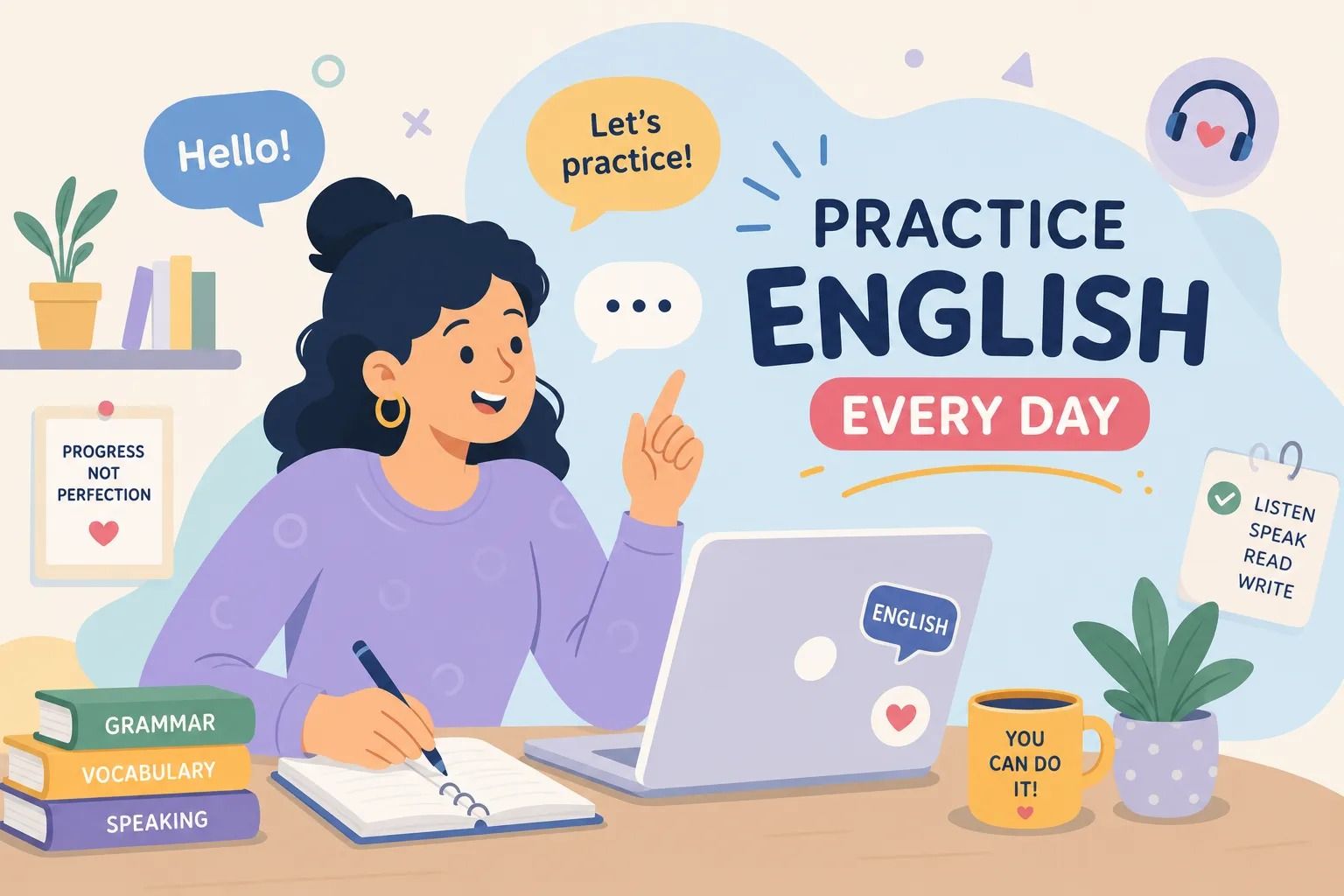
You have spent years studying English. You have used apps, worked through grammar books, watched video lessons, and still, the moment someone asks you a question in a real conversation, your mind goes completely blank. The problem is not your effort or your intelligence. The problem is structure, or rather, the lack of it. A consistent daily English practice routine, built around active output, not passive consumption, is what separates learners who improve quickly from those who stay stuck. Many learners focus far more on absorbing English passively than on actually producing it out loud, and that imbalance is usually the real culprit.
The fix is simpler than you think. A repeatable daily English practice schedule built around three focused blocks: a morning listening session, an afternoon vocabulary session, and an evening speaking session. Each block runs just 10 to 15 minutes, uses free resources, and builds directly on the one before it. Together, they add up to a manageable 30 to 45 minutes a day. By the end of 30 days, many learners report noticeably less hesitation and a genuine boost in confidence, though individual results will vary depending on starting level and consistency. This guide walks through exactly how to run each block, what to use, and how to know it is working.
Morning routine: start your day with active listening
The right sources for a daily English practice listening session
The best free resources for a morning listening habit are short, consistent, and built around natural spoken dialogue. Channels like Daily English Conversation, Learn English with Jessica, and Speak English With Vanessa on YouTube offer dialogues under 15 minutes that cover real situations rather than textbook English. TalkEnglish.com carries a free audio library with over 10,000 English speaking practice audio files, a useful bank of material for this block. Podcasts like All Ears English work well if you prefer audio without a screen in the morning.
Here is the most important rule for this block: choose one short clip and listen to it every single day for a full week. Do not switch content daily. Repetition builds familiarity with rhythm, pronunciation, and connected speech patterns far faster than variety does. By day four or five, you will start catching phrases you completely missed on day one.
How to listen actively, not just passively
Background listening, the kind where English plays while you cook or commute, has almost no effect on fluency. Active listening is different. It means pausing after each sentence, repeating it aloud, and noting unfamiliar phrases. A simple notebook or a phone notes app is all you need. The goal is not to understand every word; it is to train your ear to catch natural speech patterns and connected sounds that textbooks never teach.
The one-minute vocabulary capture habit
After the session ends, spend one minute writing down three to five phrases from the audio. Not isolated words, full phrases. “I’m running a bit late” is more useful than just “late,” because it gives your brain a ready-made unit to retrieve under pressure rather than a bare word to assemble into a sentence. These phrases become the raw material for your afternoon vocabulary block, so the three sessions genuinely connect to each other rather than sitting in isolation.
Afternoon block: build vocabulary through daily-life topics
Why sentence banks beat word lists
Memorising a list of isolated vocabulary almost never transfers to actual speaking. The brain stores words without the grammatical context needed to produce them under pressure. Sentence-based learning works because it gives the brain a complete, ready-to-use unit. Language teachers have observed for decades that phrases grouped by real-life situations (greetings, shopping, health, workplace conversations) transfer directly into live speech because the brain retrieves the whole phrase rather than assembling it from parts on the fly.
The six conversation topic groups to master first
- Greetings and introductions: They open every conversation. Phrases like “I’m new here, could you point me in the right direction?” or “How’s your day going so far?” remove the awkward silence of not knowing how to begin.
- Shopping and errands: These come next. “Do you have this in a different size?” and “Is this on sale?” are phrases you will use weekly in real life.
- Travel and transport: Navigating a new place is genuinely stressful in a second language, making these phrases vital.
- Health phrases: Essentials like “I’m not feeling well” or “I need to see a doctor” are basics every learner should have ready.
- Workplace phrases: Critical for professional settings, such as “Can we reschedule?” and “I’ll follow up by email.”
- Social small talk: Weather, food, and weekend plans form the glue that holds relationships together, and it is often the hardest to practise from a textbook.
These six groups cover most of the conversation topics for daily use that come up in real life.
A 10-minute afternoon drill for daily English conversation practice
The drill itself is straightforward. Read five phrases from your morning vocabulary capture aloud. Then personalise each one by substituting details from your own life. If the phrase is “I love travelling to new cities,” change it to “I love travelling to Coorg because the weather there is perfect.”
Connecting new language to personal memory dramatically improves recall during real conversations. This is not a passive exercise; say each sentence out loud, not just in your head. Working through daily English sentences this way, personalised and spoken aloud, is far more effective than silent review.
Evening session: the speaking practice that actually builds fluency
The 10-minute fluency routine, step by step
The evening session follows four steps:
- Start by listening to the morning clip one more time for two minutes.
- Personalise a phrase from it in a spoken sentence about your actual day, something like, “Just like the person in the audio, I had a really busy afternoon today.”
- Free-talk continuously for two minutes without stopping. Keep speaking even if you resort to very simple words when you get stuck. Flow matters far more than perfection at this stage.
- Spend two minutes reflecting on what felt smooth and what felt stuck, so your brain is primed for improvement the next day.
Finding real conversation partners without scheduling pressure
The evening session works best when it ends with a live conversation rather than solo practice. This is exactly where most learners get stuck. Finding someone to practise with at 9 PM without booking a session days in advance feels impossible. On many platforms, it genuinely is.
Talk4now is designed to solve this directly. It offers open voice conversation rooms where learners can join ongoing discussions, filter by topic or language level, and start speaking without a formal appointment or tutor fee. The option to listen before joining is particularly useful for beginners who need a moment to warm up before they find their voice.
What to talk about in your first few sessions
Start with the topics from your afternoon sentence bank. Introduce yourself, describe your day, or ask a simple question about the other person’s experience. Sticking to familiar territory removes one variable from the equation: what to say. When you are not searching for content, you can focus entirely on saying it out loud, which is the actual skill you are building.
Your 30-day daily English practice calendar
Week 1 and 2: Listening and vocabulary as the foundation
The first two weeks are deliberately light on speaking. The priority is training your ear and building a personal sentence bank of 60 to 80 phrases grouped by situation. Your daily commitment across the three blocks is around 30 to 45 minutes. That might feel repetitive, but repetition is the point. It builds pattern recognition without cognitive overload, and by the end of week two, you will find yourself producing phrases from the clip without even consciously recalling them.
Week 3 and 4: Shift to speaking-first practice
Weeks three and four change the balance significantly. The free-talk block doubles from 2 minutes to 4 to 5 minutes. Live conversations become a nightly habit rather than an occasional one.
You also begin applying the 4/3/2 technique: deliver the same four-minute talk three times—first in four minutes, then three minutes, then two. This forces you to express the same ideas more smoothly and quickly with each round, building both fluency and speed simultaneously without any additional preparation. By week four, your daily English conversation practice will feel noticeably more natural than it did on day one.
How to keep going after day 30
Learners who complete 30 consistent days consistently report noticeably less hesitation and faster recovery after mistakes, particularly those who include live speaking practice in their evening block. The schedule stays the same after day 30; only the complexity of the content increases. You move to longer clips, more advanced topics, and conversations with a wider range of speakers. The structure that got you here is the structure that keeps you moving.
Measuring your progress with simple weekly checkpoints
Four metrics any learner can track at home
You do not need a teacher to measure progress. Track four things weekly:
- Comprehension: Can you summarise a short audio clip in your own words without notes?
- Fluency: Are the pauses in your free-talk recordings getting shorter week by week?
- Interaction: Do you ask natural follow-up questions during live conversations rather than just answering and going quiet?
- Pronunciation: Are you stressing words correctly to change meaning, as in “I didn’t say she stole it” versus “I didn’t say she stole it”?
A basic phone recording is all you need for this.
The self-recording method that makes progress visible
On day one of the plan, record a two-minute free talk on any topic you choose. On day 30, record the same topic again. The difference in hesitation, vocabulary range, and sentence length is usually striking enough to be genuinely motivating.
Weekly recordings, not just the day-one and day-thirty comparison, help you spot micro-improvements that keep motivation high between the big milestones. Progress in language learning is steady but quiet; recording makes it visible.
Start today, not next week
Daily English practice does not require hours of study or expensive tutors. It requires a consistent 30 to 45 minute routine split across three focused blocks. Morning listening sharpens your ear, and afternoon drills wire new phrases into memory through personal connection. Evening speaking sessions, especially with real people in live conversations, turn that stored knowledge into fluency you can actually use.
The 30-day English speaking plan gives you the structure. The weekly checkpoints make progress measurable. You now have everything you need to begin. If the full schedule feels overwhelming on day one, start with just the morning block. One block done consistently beats three blocks started and abandoned every single time. Keep it simple, keep it daily, and the fluency will follow.
When you are ready for the evening speaking session, Talk4now is there: live, unscripted conversation rooms available whenever you open the app, with real people who are there for exactly the same reason you are.

Written by
Kano
Content Manager & SEO Expert